Foreword
The art of dining transcends mere sustenance; it embodies civilization, chronicles history, and forges emotional bonds. Hebei cuisine, a gift from the Yan-Zhao land, carries the rich simplicity of agrarian culture while embracing the generous spirit of mountains, rivers, and seas.
From the endless wheat fields of the Central-Southern Hebei Plains to the succulent seafood along the Bohai coast; from the refined elegance of Zhili official cuisine to the rustic heartiness of country stews; from the crispy, savory aroma of donkey meat buns to the smooth, chewy texture of a bowl of noodles—every bite carries the hometown memories of the people of Yan and Zhao.
Hebei's culinary landscape balances the steadfast tradition of slow-simmered broths with the dynamic flair of quick stir-fries. Through the harmonious blend of five flavors, these dishes embody the straightforward and down-to-earth character of the people. Amidst steaming, boiling, frying, and stir-frying, they transform life's hardships and aspirations into timeless flavors.
Starting today, the “Interpreting Hebei's Intangible Cultural Heritage” series presents its culinary chapter. Let us follow the wispy smoke rising from the hearth to trace the roots of Hebei's cuisine, witnessing how it has woven a rich and enduring cultural tapestry through the tides of time.
Intangible Cultural Heritage
Hebei Cuisine: Millennia of Flavors Cooked Up in Yan and Zhao
Hebei cuisine, also known as Ji cuisine, draws from the province's diverse landscapes and abundant produce. Natural gifts like Yutian cabbage, Qianxi chestnuts, Wangdu chili peppers, Chengde venison, Bashang mushrooms, Baiyangdian garfish, and Bohai shrimp form the foundation of this culinary tradition.
With a history stretching back millennia, Hebei cuisine has evolved into a unique blend of “mountain and sea flavors, harmonizing five tastes.” Classic dishes include Braised Pork with Radish, Imperial Banquet Pork Hock, Manchu-Han Imperial Feast, Chicken in a Pot, Governor's Tofu, and Li Hongzhang's Braised Vegetables.
Today, Hebei cuisine has evolved into four major schools: Zhili Official Cuisine, Eastern Hebei Coastal Cuisine, Frontier Imperial Cuisine, and Central-Southern Hebei Plains Cuisine. Notably, the culinary techniques of Zhili Official Cuisine were inscribed on the National Intangible Cultural Heritage List in 2011. Additionally, dozens of culinary techniques—including Chai Gou Bao Town Smoked Pork, Manchu-Han Imperial Feast, and Gao Beidian Shredded Tofu—have been included in Hebei Province's provincial-level intangible cultural heritage list.
One Dish, One Soup: Embracing the Essence of North and South
On the bookshelf in the office of Kong Runchang, a master of Chinese culinary culture and scholar of food traditions, rests a simple yet substantial volume. Its off-white cover bears four gold-embossed characters—“Chongli Menu”—glowing softly.
Opening this menu reveals a parade of Hebei's traditional delicacies: Grand Banquet Pork Knuckle, Golden Lionfish, Li Hongzhang's Braised Vegetables, Chicken in a Pot... Designed specifically for the Zhangjiakou competition zone of the 2022 Beijing Winter Olympics and Paralympics, the “Chongli Menu” centers on Hebei cuisine, encompassing 360 dishes and desserts. In Kong Runchang's view, this menu highlights the distinctive flavors of Hebei cuisine and marks a recent high point for the culinary tradition.
These dishes, originating from diverse regions and boasting varied flavors, embody the profoundly inclusive nature of Hebei cuisine.
Within China's culinary landscape, Hebei cuisine is often overlooked for lacking distinct characteristics. In reality, throughout history, Hebei cuisine has revealed its charm through absorption, adaptation, and fusion—demonstrating mastery in simplicity and creating myriad flavors through integration.
The Hebei region borders grasslands to the north, connects to the Central Plains to the south, faces the Bohai Sea to the east, and leans against the Taihang Mountains to the west. This land, the ancient domain of Yan and Zhao, the gateway to the imperial capital, has long been a crossroads where nomadic and agrarian cultures, imperial delicacies and folk cuisine, collide.
Flavors from diverse regions clash here, cultures of multiple ethnic groups blend, ultimately crystallizing into the unique taste of this land. The evolution of Hebei cuisine parallels the cultural exchanges between Central Plains civilization and minority cultures. Over 2,000 years ago, during Zhang Qian's missions to the Western Regions in the Western Han Dynasty, numerous culinary ingredients native to those lands—such as alfalfa, melon, broad beans, pepper, and sesame—were introduced to the Central Plains. Among these, melon was first cultivated in the Hebei region.
Legend has it that Shi Le, founder of the Later Zhao Dynasty (with its capital in Xingtai), once used cucumbers to test his ministers' loyalty. The scholar Fan Tan cleverly avoided the taboo character “Hu” by describing them as “jade-plate cucumbers,” thereby integrating this exotic ingredient into the Chinese lexicon and symbolizing ethnic harmony. To this day, the Cucumber Banquet—featuring cucumbers as the main ingredient—remains a renowned feast in Shijiazhuang.
Over the following millennium, Hebei served as a pivotal crossroads connecting north and south, east and west. Its cuisine and culinary techniques evolved through continuous exchange and fusion.
When the Yuan Dynasty established its capital in Beijing, over the next 700-plus years, culinary cultures from across the nation—including regional specialties, cooking techniques, and banquet etiquette—flowed into the capital and radiated outward to Hebei, the imperial hinterland. This marked a new phase in the evolution of Hebei cuisine.
As a national intangible cultural heritage, Zhili Official Cuisine emerged through this continuous fusion.
“Baoding, named for ‘guarding the capital and stabilizing the realm,’ served as the seat of the Qing Dynasty's Zhili Governor. It long attracted officials and merchants traveling north and south.” Liang Lianqi, a nationally recognized inheritor of Zhili Official Cuisine cooking techniques, explained that Baoding attracted master chefs from across the country. The establishment of regional guild halls further accelerated the development and fusion of dishes. By the mid-to-late Qing Dynasty, Zhili Official Cuisine had matured and reached its zenith.
“A single dish can capture the flavors of half of China,” Liang remarked as he opened a yellowed old cookbook, where Li Hongzhang's Braised Delicacy stood out prominently.
This dish, born in the late Qing Dynasty, blends sea cucumber, deer tendon, Chinese cabbage, tofu, and other ingredients. All components harmonize seamlessly under the seasoning of locust-tree bean paste. Legend has it that when Li Hongzhang was on diplomatic missions to Europe and America, his homesickness prompted the chefs in his residence to combine delicacies from land and sea with local produce, creating this fusion dish.
The fusion of Zhili official cuisine extended beyond the blending of ingredients to encompass social integration. During the Qing Dynasty, many chefs serving the Zhili Governor-General came from the imperial court. They brought the refined techniques of imperial cuisine into the civilian sphere while also absorbing the rustic flavors of the common folk.
Take Chicken and Shrimp Stir-fry, for instance: fresh Baiyangdian shrimp and farm-raised chicken are stir-fried together, their tender texture and savory aroma exploding in the wok's intense heat. This humble fisherman's dish, refined by imperial chefs, became a refined banquet delicacy.
This culinary wisdom—drawing from imperial refinement while connecting with everyday life—endowed Zhili official cuisine with both nobility and down-to-earth appeal. Its aromas still waft from restaurants across Baoding's streets today.
Hundreds of kilometers northeast of Baoding, Tangshan's Jingdong cuisine—bearing the imprint of modern industry—emerged as an early pioneer in blending northern and southern Chinese culinary traditions, as well as integrating Western influences within Hebei's culinary landscape.
During the late 19th and early 20th centuries, Tangshan flourished as a coal mining hub, attracting immigrants from all corners of the country. Skilled workers from Guangdong, merchants from Northeast China, and even foreign managers and engineers brought their distinct culinary preferences to this burgeoning industrial city.
“At its core, East Jing cuisine is fusion cuisine,” " explained He Baoliang, general manager of the time-honored restaurant Hongyan Fanzhuang. In the early days, coal miners needed hearty meat dishes to replenish their energy, making pork knuckles and braised meats the stars of the table. Meanwhile, Westerners and Cantonese immigrants introduced the sophistication of Western cuisine and the delicacy of Cantonese cooking, elevating the precision of knife work and seasoning in East Jing cuisine.
This fusion unfolded quietly throughout the process.
Within China's culinary landscape, Hebei cuisine is often overlooked for lacking distinct characteristics. In reality, throughout history, Hebei cuisine has revealed its charm through absorption, adaptation, and fusion—demonstrating mastery in simplicity and creating myriad flavors through integration.
The Hebei region borders grasslands to the north, connects to the Central Plains to the south, faces the Bohai Sea to the east, and leans against the Taihang Mountains to the west. This land, the ancient domain of Yan and Zhao, the gateway to the imperial capital, has long been a crossroads where nomadic and agrarian cultures, imperial delicacies and folk cuisine, collide.
Flavors from diverse regions clash here, cultures of multiple ethnic groups blend, ultimately crystallizing into the unique taste of this land. The evolution of Hebei cuisine parallels the cultural exchanges between Central Plains civilization and minority cultures. Over 2,000 years ago, during Zhang Qian's missions to the Western Regions in the Western Han Dynasty, numerous culinary ingredients native to those lands—such as alfalfa, melon, broad beans, pepper, and sesame—were introduced to the Central Plains. Among these, melon was first cultivated in the Hebei region.
Legend has it that Shi Le, founder of the Later Zhao Dynasty (with its capital in Xingtai), once used cucumbers to test his ministers' loyalty. The scholar Fan Tan cleverly avoided the taboo character “Hu” by describing them as “jade-plate cucumbers,” thereby integrating this exotic ingredient into the Chinese lexicon and symbolizing ethnic harmony. To this day, the Cucumber Banquet—featuring cucumbers as the main ingredient—remains a renowned feast in Shijiazhuang.
Over the following millennium, Hebei served as a pivotal crossroads connecting north and south, east and west. Its cuisine and culinary techniques evolved through continuous exchange and fusion.
When the Yuan Dynasty established its capital in Beijing, over the next 700-plus years, culinary cultures from across the nation—including regional specialties, cooking techniques, and banquet etiquette—flowed into the capital and radiated outward to Hebei, the imperial hinterland. This marked a new phase in the evolution of Hebei cuisine.
As a national intangible cultural heritage, Zhili Official Cuisine emerged through this continuous fusion.
“Baoding, named for ‘guarding the capital and stabilizing the realm,’ served as the seat of the Qing Dynasty's Zhili Governor. It long attracted officials and merchants traveling north and south.” Liang Lianqi, a nationally recognized inheritor of Zhili Official Cuisine cooking techniques, explained that Baoding attracted master chefs from across the country. The establishment of regional guild halls further accelerated the development and fusion of dishes. By the mid-to-late Qing Dynasty, Zhili Official Cuisine had matured and reached its zenith.
“A single dish can capture the flavors of half of China,” Liang remarked as he opened a yellowed old cookbook, where Li Hongzhang's Braised Delicacy stood out prominently.
This dish, born in the late Qing Dynasty, blends sea cucumber, deer tendon, Chinese cabbage, tofu, and other ingredients. All components harmonize seamlessly under the seasoning of locust-tree bean paste. Legend has it that when Li Hongzhang was on diplomatic missions to Europe and America, his homesickness prompted the chefs in his residence to combine delicacies from land and sea with local produce, creating this fusion dish.
The fusion of Zhili official cuisine extended beyond the blending of ingredients to encompass social integration. During the Qing Dynasty, many chefs serving the Zhili Governor-General came from the imperial court. They brought the refined techniques of imperial cuisine into the civilian sphere while also absorbing the rustic flavors of the common folk.
Take Chicken and Shrimp Stir-fry, for instance: fresh Baiyangdian shrimp and farm-raised chicken are stir-fried together, their tender texture and savory aroma exploding in the wok's intense heat. This humble fisherman's dish, refined by imperial chefs, became a refined banquet delicacy.
This culinary wisdom—drawing from imperial refinement while connecting with everyday life—endowed Zhili official cuisine with both nobility and down-to-earth appeal. Its aromas still waft from restaurants across Baoding's streets today.
Hundreds of kilometers northeast of Baoding, Tangshan's Jingdong cuisine—bearing the imprint of modern industry—emerged as an early pioneer in blending northern and southern Chinese culinary traditions, as well as integrating Western influences within Hebei's culinary landscape.
During the late 19th and early 20th centuries, Tangshan flourished as a coal mining hub, attracting immigrants from all corners of the country. Skilled workers from Guangdong, merchants from Northeast China, and even foreign managers and engineers brought their distinct culinary preferences to this burgeoning industrial city.
“At its core, Jingdong cuisine is fusion cuisine,” explains He Baoliang, general manager of the time-honored Hongyan Restaurant. In the early days, coal miners required hearty, meaty dishes like braised pork knuckle and preserved meats to replenish their strength. Meanwhile, Westerners and Cantonese immigrants introduced the refinement of Western cuisine and the delicacy of Cantonese cooking, elevating Jingdong cuisine's knife skills and seasoning techniques.
This fusion is evident in a Tangshan cookbook published in the 1970s, which features Shandong-style stir-fries and deep-fried dishes alongside Cantonese-style sausages and Western-style braised chicken. “Such combinations were uncommon back then,” noted He Baoliang.
Since its founding in 1937, Hongyan Restaurant has witnessed Tangshan's transformation from a mining and metallurgical hub to an industrial metropolis, encapsulating the story of Jingdong cuisine's fusion and perseverance.
Amid the clanging of iron spoons against wok rims in the kitchen, a plump pork knuckle simmers in rich sauce. Meticulously sliced pork kidneys unfurl like wheat ears in sizzling oil, while glistening shrimp chips coated in thick gravy are arranged on porcelain plates... Every dish and soup here embodies the essence of fusion.
The narrative of Hebei cuisine grows through fusion, reborn in its evolution.
Where Mountains and Seas Converge, a Symphony of Flavors Unfolds
At dawn, as mist still lingers over Baiyangdian Lake, Old Zhang, a fisherman from Dongdiantou Village in Anxin County, Xiong'an New Area, glides his small boat through the reed beds. His bamboo basket brims with freshly caught green shrimp and live fish—essential ingredients for Baiyangdian's signature fish banquet.
Over 200 kilometers southwest, villagers in Shuizhagou Village, deep within the Taihang Mountains of Pingshan County, prepare to feed their free-range black pigs. These pigs, raised on farm grains, provide the finest ingredients for the traditional delicacy Shuizhagou cured pork.
Meanwhile, in Fengning Manchu Autonomous County in northern Hebei, chefs at Hongyue Buckwheat Noodles Village are preparing for the midday roast whole lamb.
Every morning in Hebei begins with such scenes of everyday life.
As China's only province encompassing plateaus, mountains, hills, plains, lakes, and coastlines, Hebei is hailed by geographers as a “condensed national geographic museum.” Its 188,800 square kilometers of land and diverse topography have endowed Ji cuisine with a unique genetic makeup characterized by “harmonizing mountain and sea flavors, blending five tastes.”
“Sourcing locally and selecting ingredients meticulously are hallmarks of Ji cuisine,” Kong Runchang explains that in the past, when transportation was less convenient, the abundant local ingredients provided a solid and advantageous foundation for the development of Hebei cuisine, giving rise to distinctive regional flavors across the province.
On May 5th, a wheat field in Dongquancheng Village, Xin'an Town, Zhengding County, was filled with wheat plants in full bloom, vibrant with life. A month later, this expanse of green will transform into a sea of gold as harvest time arrives.
Among the diverse topography of the Yan-Zhao region, the plains—covering 43.4% of the total area—have become the most populous and prosperous zones due to their fertile soil and favorable climate. Consequently, various wheat-based noodle dishes have emerged as the most common staple food across this land.
From steamed buns to flatbreads, from donkey meat buns to clay-oven crackers, noodle dishes are masterfully crafted in restaurants and homes across central and southern Hebei.
Noodles are an indispensable staple on Hebei dining tables. Drawing on local ingredients, Hebei locals have masterfully developed diverse noodle accompaniments: coastal shrimp oil noodles offer rich savory depth, plain sesame noodles provide refreshing coolness, Zhangjiakou's mushroom noodle soup boasts thick broth and vibrant flavor, while Shijiazhuang's Lingshou County pickled meat noodles deliver salty aroma and chewy texture...
Hebei is predominantly mountainous, with mountainous terrain covering more area than plains. The plateau region, occupying only 8.5% of the province, has cultivated a distinct Daming Mountain style unlike most of Hebei. These vast mountainous and plateau landscapes have imbued Ji cuisine with unique characteristics. The imperial cuisine of the frontier regions epitomizes this distinctive culinary tradition.
“During the Kangxi Emperor's reign in the Qing Dynasty, the Mulang Hunting Ground and Summer Palace were constructed in Chengde. Under the Kangxi and Qianlong emperors, nearly half the year was spent here. Imperial cuisine collided with local wild game, blending Manchu, Han, Hui, and Mongolian culinary traditions to gradually form the Outer Court Cuisine,” explains Sun Xiaochun, Vice President of the China Cuisine Association and Chair of its Master Chefs Committee.
Represented by Chengde's imperial cuisine, this culinary tradition encompasses regional dishes from Chengde, Zhangjiakou, and beyond. Unlike the imperial fare of the capital, it incorporates characteristics of multiple ethnic cuisines. Primarily utilizing local mountain delicacies and wild game, it excels in techniques such as deep-frying, roasting, stewing, stir-frying, and clay-oven baking. It is renowned for its crispy textures, fresh flavors, and savory richness.
Chai Gou Bao Smoked Pork, Roasted Whole Deer, Stir-Fried Ruyi Vegetables, Scallion-Sautéed Lamb, Mulan Diced Meat, Walnut-Stuffed Pheasant Rolls... The fusion of mountain delicacies and wild game creates a distinctive flavor profile.
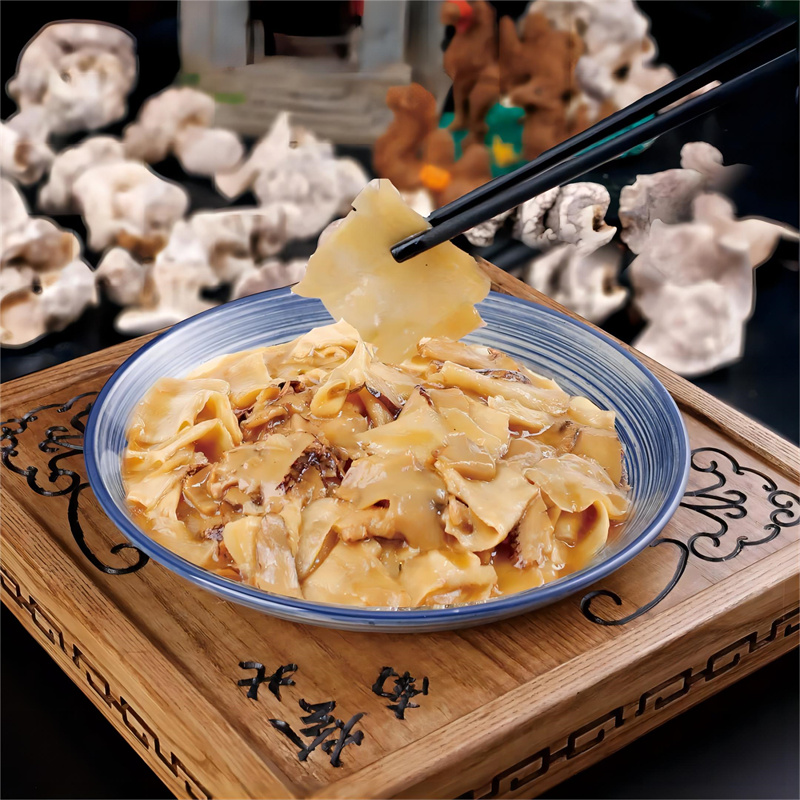
Shāo Nánběi, a renowned Zhangjiakou dish featured on the “Chongli Menu,” derives its name from its key ingredients: mushrooms from the north and bamboo shoots from the south.
Mushrooms predominantly harvested from Inner Mongolia's grasslands are collectively termed “Kou mushrooms” due to their distribution through Zhangjiakou. When cooked, Kou mushrooms impart a distinct aroma, enhancing both texture and umami richness. When these mushrooms meet bamboo shoots from the Jiangnan region, the tender smoothness of the mushrooms combines with the crisp freshness of the bamboo shoots. This simple vegetable pairing preserves each ingredient's distinct texture while achieving a perfect fusion, resulting in a dish that is both deliciously savory and refreshingly crisp, with a rich, aromatic flavor.
This fusion dish, transcending geographical boundaries, not only showcases the produce of the Bashang region but also bears witness to Zhangjiakou's historical role as a key transportation hub and important trading port.
Compared to mountain delicacies, Hebei's seafood offerings are equally impressive. The Bohai Sea, embraced by Hebei's 487-kilometer coastline, yields abundant high-quality marine products.
Each September during the fishing season, coastal fishermen haul in a bounty of fresh seafood from the Bohai Sea: crabs, scallops, tiger prawns, clams, conch, mantis shrimp... the variety is truly extensive.
The uniqueness of Hebei seafood lies in the synergy between land and sea. In Cangzhou, seafood dumpling soup is a popular staple on restaurant menus. Seafood dumplings and steamed seafood dumplings, filled with diverse ingredients, perfectly blend the satisfying fullness of carbohydrates with the freshness of the sea.
From the Badong Plateau to the Bohai coast, from the Taihang foothills to the North China Plain, Hebei's diverse geography fuels the boundless possibilities of its cuisine. Behind every dish lies the natural code of its mountains, rivers, and soil. (By Wang Sidai, Li Jiancheng, and Wang Yumin, Hebei Daily)
Related
“Chongli Menu” Showcases Unique Charm of Hebei Cuisine
The successful hosting of the 2022 Beijing Winter Olympics not only showcased the athletic prowess of China's winter athletes to the world but also elevated the “Chongli Menu” into a shining emblem of Hebei's culinary culture. This menu, embodying the craftsmanship of Yan and Zhao regions, centers on Hebei cuisine while blending tradition with innovation, presenting the world with the distinctive allure of Hebei flavors.
“Development of the ‘Chongli Menu’ began in November 2018 to serve guests from all corners of the globe during the Beijing Winter Olympics and Paralympics,” explained Kong Runchang, a master of Chinese culinary culture and scholar of food traditions.
Comprising 360 dishes and desserts, the Chongli Menu adheres to rigorous selection criteria across multiple dimensions.
First, it must highlight Hebei's distinct characteristics, prioritizing local ingredients, techniques, and tableware. For instance, the dish “Koi Playing with Pearls,” developed by Master Kong's studio, uses ancient Ping Shan moon-aged tofu and wild crucian carp from Bai Po Lake, showcasing pronounced regional flair.
Additionally, the menu emphasizes diverse pairings, encompassing hot and cold dishes, staples, and desserts, balancing renowned delicacies with home-style fare.
During development, a balance between tradition and innovation is crucial: classic dishes require deep exploration, adapted dishes must integrate foreign flavors, while innovative creations pursue breakthroughs in ingredients and techniques. For instance, Tangshan Hongyan Restaurant's “Braised Tomatoes in Clay Pot” and “Chess-Piece Flatbread” preserve traditional essence within standardized production.
Finally, dishes must adapt to multiple scenarios, flexibly configurable into banquets, buffets, and over five other dining formats to meet diverse needs.
The development of the “Chongli Menu” represents an in-depth exploration of Hebei's culinary heritage. The team delved into local communities to uncover intangible cultural heritage techniques and time-honored brands—such as Zhengding's Banggan (stir-fried liver), Gaocheng's Gongmian (hand-pulled noodles), and kiln-fired flatbreads—elevating local specialties into culinary art. Simultaneously, the dishes emphasize health-conscious principles, featuring light oil, reduced salt, and balanced nutrition.
To ensure the “Chongli Menu” reaches the public beyond the Winter Olympics, Hebei designated 103 “Ji Cuisine · Chongli Menu” brand promotion demonstration restaurants. These include time-honored establishments, nationally certified green hotels, and Winter Olympics contracted venues. Each restaurant must incorporate at least 25 dishes into daily operations and offer them as banquet options.
Today at Tangshan Hongyan Restaurant, dishes like Honey-Glazed Sesame Leaves and Hongyan Pork Knuckle have become popular choices among diners, thanks to standardized production and the added appeal of Winter Olympics memories.
Notably, 85% of the “Chongli Menu” features accessible dishes. Items like Shijiazhuang's Sweet Potato and Black Arrowhead Soup and Zhangjiakou's Olympic Rings Buckwheat Noodles originate from local kitchens, allowing residents to savor Winter Olympics flavors right in their neighborhoods.
Currently, through demonstration restaurant promotions and market-driven operations, the “Chongli Menu” is helping Hebei cuisine transcend regional boundaries and reach broader stages.
From serving the Winter Olympics to gracing everyday tables, from traditional techniques to international expression, the “Chongli Menu” uses cuisine as a medium to write a new chapter in Hebei's culinary culture. This transformation unfolds quietly yet profoundly.